

The dog breeds most tied to royalty are the Pembroke Welsh corgi, the Cavalier King Charles spaniel, the Pekingese, the Shih Tzu, the pug, the Great Pyrenees, the Pomeranian and the Labrador retriever. Each one earned its place in a palace, a royal kennel or a famous king’s lap. Below are 12 breeds with real royal history, the story behind each, and which of the old tales are probably more legend than fact.
One thing before the list: your dog doesn’t need a royal pedigree to look like royalty. That part is easy to fix, and we’ll get to it at the end.
1. Pembroke Welsh corgi
No breed is more linked to one monarch. Queen Elizabeth II owned more than 30 corgis over her reign, starting with a corgi named Susan she was given for her 18th birthday in 1944. Most of the royal corgis that followed were Susan’s descendants. Her corgi crossed with Princess Margaret’s dachshund also gave the world the “dorgi.”

2. Cavalier King Charles spaniel
The name says it all. King Charles II of England, in the 1600s, was so fond of his little toy spaniels that they took his name. The modern Cavalier was bred back in the 1920s to look like the spaniels in paintings from his court, with a flatter head than today’s King Charles spaniel and a longer nose.

3. Pekingese
For centuries the Pekingese belonged to China’s imperial court, and ordinary people weren’t meant to own one. The breed reached Britain in a much less charming way. When British and French troops looted the Old Summer Palace near Beijing in 1860, a small Pekingese was taken and given to Queen Victoria. She named the dog Looty. She is often described as the first Pekingese in Britain.
4. Shih Tzu
The Shih Tzu was another favorite of the Chinese imperial palace, where small “lion dogs” were bred and kept by the court. The name itself means “lion,” and the breed was carefully bred inside the palace walls, long before it reached Europe and America in the 20th century.
5. Pug
Pugs came from China too, but their royal fame is mostly Dutch. The story goes that in 1572 a small dog named Pompey woke William the Silent, Prince of Orange, when assassins crept toward his tent, and the pug became the favorite dog of the House of Orange. It’s a lovely story, but treat it as legend: historians still argue about whether Pompey was even a pug. What is better documented is that William III and Mary II brought pugs with them to England in 1688.
6. Great Pyrenees
These big white dogs guarded sheep in the mountains between France and Spain for centuries. Their royal moment came at the court of Louis XIV, which, according to the usual telling, named them the Royal Dog of France in 1675. The details vary depending on who tells it, but the breed did become fashionable among the French nobility, who used them to guard their estates.
7. Pomeranian
Early Pomeranians were much bigger than the fluffy lap dogs you see today. Queen Victoria changed that. She fell for the smaller ones on a trip to Italy, brought several home and showed them, and the breed’s popularity in Britain grew from there. Breeders went smaller and smaller to match her taste.
8. Labrador retriever
The Lab is the working royal. The British royal family has kept gundogs at the Sandringham estate in Norfolk for generations, and Queen Elizabeth II bred Labradors there for much of her life. They were bred to work in the field, not to sit on cushions, which might be the most Labrador thing about them.
9. Saluki
Often called the royal dog of Egypt, the Saluki is one of the oldest dog types still around. Slim hounds that look a lot like it appear in ancient Egyptian art, and they were prized hunting dogs of rulers across the Middle East.
10. Japanese Chin
In Japan, the Chin was a companion of the imperial court and the nobility rather than a working dog. Small, catlike and very attached to its people, it was a status dog for the upper classes before it reached the West in the 1800s.
11. Borzoi
The borzoi was the hunting hound of the Russian tsars and aristocracy, who kept large kennels for elaborate hunts. After the Russian Revolution, the breed nearly vanished in its home country along with the estates that kept it.
12. Italian greyhound
Frederick the Great of Prussia adored his Italian greyhounds so much that he asked to be buried next to them. It took more than 200 years, but in 1991 he was reburied at his palace of Sanssouci, near the graves of his dogs.
What if your dog isn’t on the list?
Most dogs in royal portraits were the ones their owners loved, not the ones with the fanciest papers. A scruffy rescue looks just as noble in a velvet cloak and a ruff collar as a corgi does. That’s the idea behind a royal pet portrait: your own dog, shown in the style of an old palace portrait.
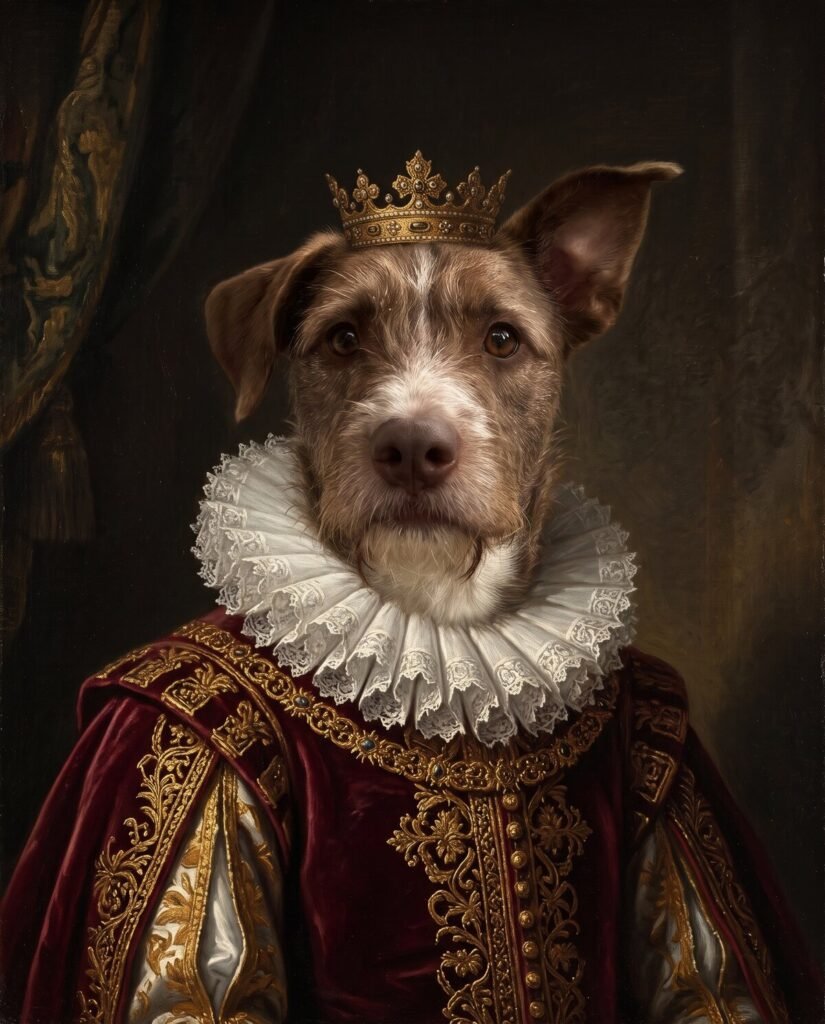
Gifted Whiskers makes royal portraits from one photo of your dog. You upload the photo, and a watermarked preview of your dog in a crown and cloak appears right on the page in a few minutes. It’s free to see, and you only order if you love it. Then choose a canvas size, and we print and ship it free in the U.S.
A few tips for the best result: use a well-lit photo where your dog’s face is sharp and fills most of the frame, and take it at their eye level. For a Christmas gift, order by December 8 so it arrives in time. More ideas are in our royal pet portraits guide.
Get an extra 10% off your first order
Works on top of our sale prices. Join our email list for your code, new portrait styles and early word on sales. A few emails a month at most.
We’ll email a link to confirm first. Unsubscribe anytime. Privacy policy.